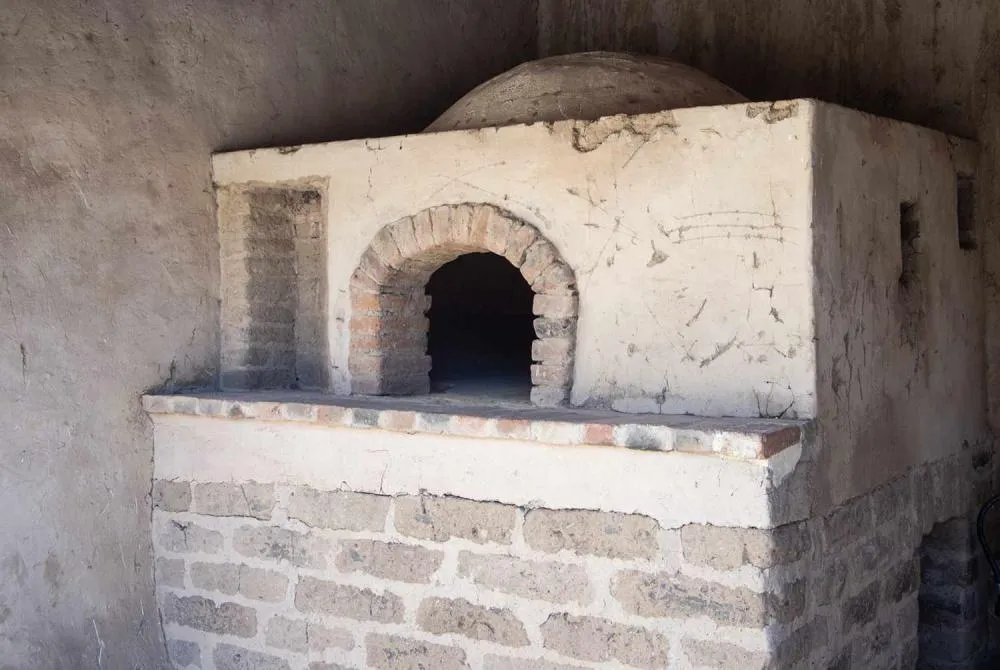

This is the bread loggia. The history of bread begins at the dawn of civilization, when, in the 6th millennium BC, humanity made its greatest discovery: agriculture. Learning to understand and master the agricultural cycle, defining the rhythm of the seasons, measuring time itself, are the foundations of a practice we now take for granted, yet one that required millions of years to develop. Sowing, harvesting and storing those golden grains that would feed a family through the long winters transformed humankind forever. Until then, people had lived as nomads, following the migrations of the great herbivorous herds they hunted.
Villages were born. Clans began to organise. More hands meant more cultivated land; more cultivated land meant larger harvests, eventually leading to the first great demographic expansion.
Wheat, selected from thousands of varieties, was first ground in the simplest way imaginable: seeds were placed on a hard stone surface and crushed by striking them with another stone. Later, this percussion method gave way to a more practical and efficient one: the rubbing together of two stones. This innovation anticipated the optimization of the milling process. By placing one stone above another, carving a hole in the upper stone through which grain could be poured and rotating the system, people finally obtained a fine, clean flour suitable for making dough. This discovery led to the first stacked stone millstones, like the Sardinian example whose origins date back to the early centuries of the Roman Age. At first, the movement was manual and entrusted to women, the true custodians of milling. Later, as production increased, animal traction replaced human effort. Even so, women remained responsible for touching and working the flour and its by-products, all the way through to baking the dough that, with its unmistakable fragrance, brought humankind closer to the gods: bread.