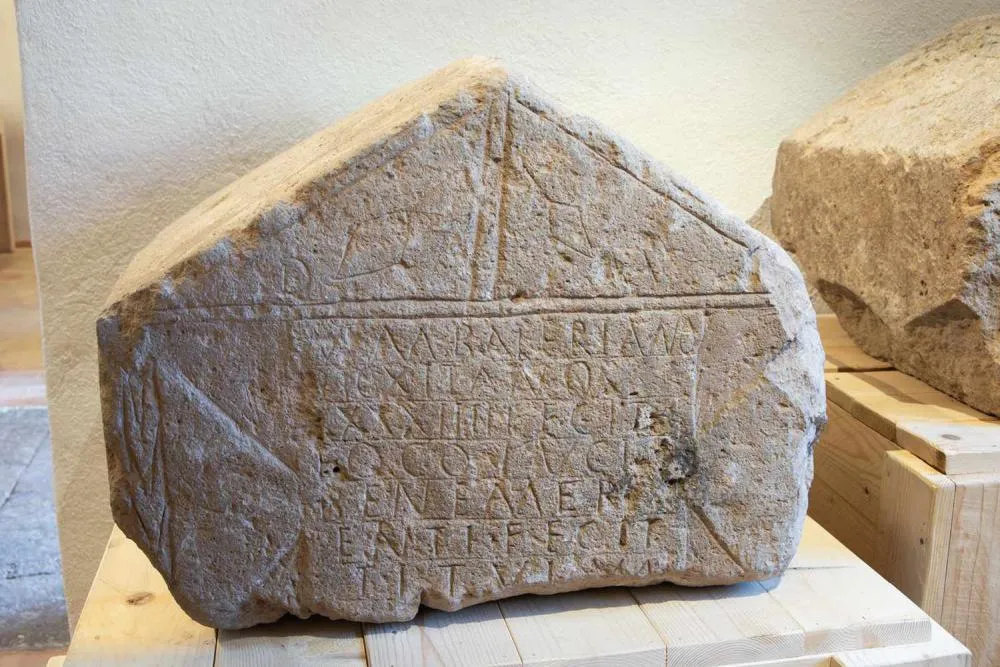

This funerary stele, discovered in the locality of Arasseda, is an important example of rural funerary epigraphy from inland Sardinia.
It is a trachyte stele shaped like a small hut, characterized by a double-pitched roof and a triangular pediment. These features clearly recall domestic architecture and symbolically evoke the dwelling place of the deceased in the afterlife. The pediment is divided by two vertical incised lines from which sketched, schematic and rigid hederae distinguentes ( ivy-leaf decorative marks ) extend. Their execution is simple but intentional. Along one edge runs a decorative pattern of overlapping “V” shapes, probably once repeated on the opposite side as well. This motif may have served either as pure decoration or as a stylized representation of the structural elements of a hut.
At the centre of the front face is a tabula ansata, the framed panel, containing the inscription. Although the lower section and parts of the sides of the stele are damaged, much of the text remains legible. The inscription is written in (Roman) capitals, carefully carved though not especially refined. Certain irregularities appear both in the guide lines and in the letter forms, for example, the letter “A” appears both with and without its crossbar. The absence of punctuation and the irregular text layout suggest a locally produced inscription rather than one created in a highly standardised workshop.
The epitaph is dedicated to the Dei Man (the spirits of the dead) and commemorates Marcus M(---) Valerianus, who died at the age of 44. The inscription was commissioned by his wife in honour of her husband, described as bene merens (“well deserving”) a common formula in Roman funerary epigraphy emphasizing the moral virtues of the deceased and the affection of surviving family members.
TRANSCRIPTION:
D(is) M(anibus), / M(arco) M(---) Baleriano / ḅicxit an(n)os / X̣XXXIIII. Fecit / ẹo (sic!) co(n)iugi / ḅene mer/enti fecit (sic!) / tituḷụṃ.
“(Consecrated) to the Spirits of the Dead. To Marcus M(---) Valerianus, (who) lived 44 years. (His wife) made (this) inscription for her husband, who was well deserving.”