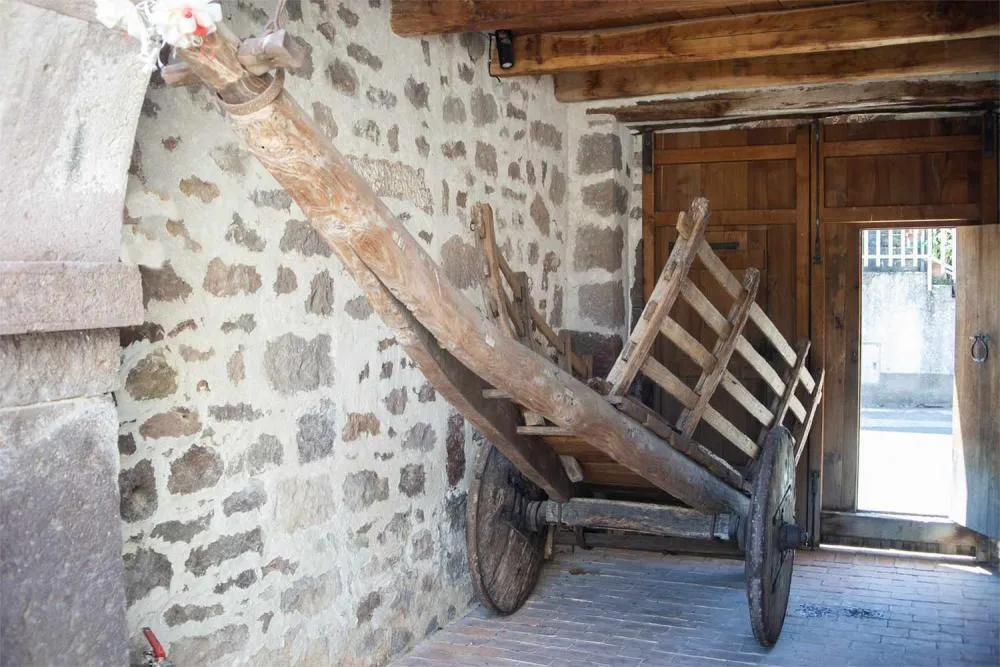
The “solid-wheel” cart preserved here represents one of the oldest systems used to transport heavy loads and was pulled by oxen. It is a true living fossil and an extraordinary rarity in the museum world, especially because of its exceptional state of preservation.
Over time, this model was replaced by carts with spoked wheels, first with ten spokes, then twelve, which were lighter and more practical.
The wheels are made from three wooden sections, often reinforced with “traversas de ferru”, or iron crossbars. At the centre of the wheel is “sa crài de s’ascia” (the axle socket), surrounded by “sa bussala” (the bushing, or metal axle hole lining). The tread itself is protected by an iron rim. The body of the cart is formed by two wooden beams called “s’iscala”, which support the base of the cart and create the loading compartment through a framework of horizontal and vertical wooden slats. At the front of “s’iscala” is “su giuàli”, the yoke to which the oxen were harnessed.
If we consider that this type of cart was already in use during Roman times and imagine the ancient road network linking the centre of the Forum Traiani, Brabaxiàna and the Parte Usèllus, it almost seems possible to hear those wheels rattling over the paving stones. A constant movement of people and goods, of salt and grain. Who knows how many carts passed over the Ponti Ecciu bridge; imagine the screeching iron, the panting of animals and how many curses shouted by the “carradòres”, the craftsmen who built and repaired the carts.
The cart was donated by the heirs of Antonio Deidda.
The hay press was donated by Mrs. Pietrina Atzori.
Exhibit setting by architect Giuseppe Pili.