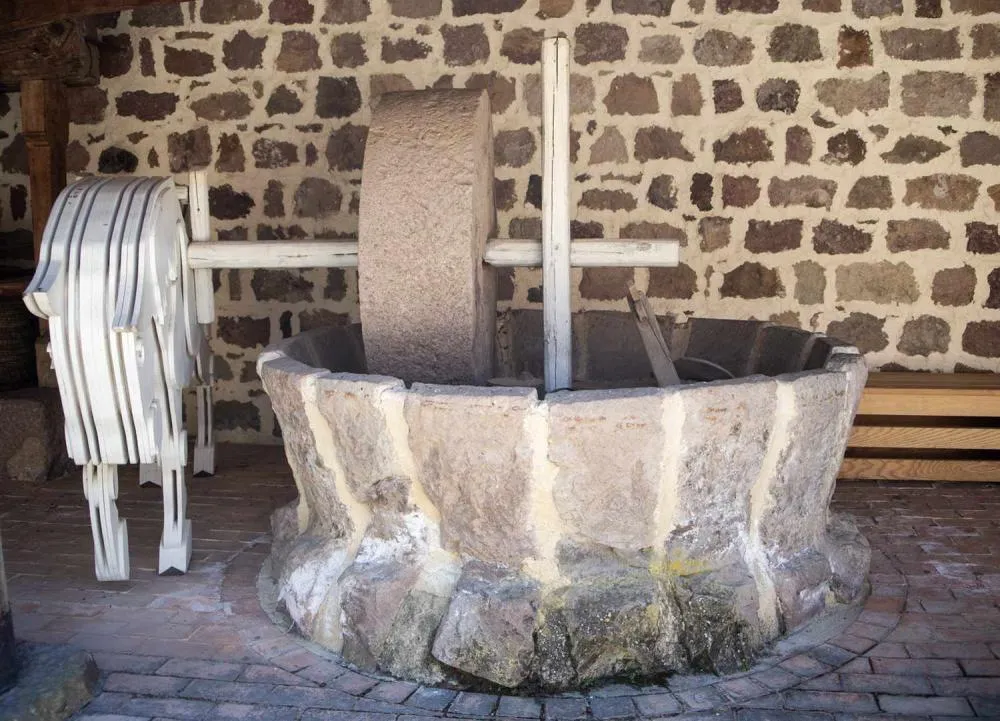

The earliest olive mills documented in history were simple stone mortars in which oily berries were crushed using stone pestles. From this primitive yet effective system, increasingly sophisticated structures gradually evolved over the centuries.
The Romans introduced some of the most important technological advances with the creation of the “trapetum”: a stone basin inside which two circular grinding wheels rotated, attached to a long wooden beam pushed by the arms of slaves.
From the “trapetum”, mills with a stone base, basin and a single grinding wheel turned by animal power, usually horses or oxen, developed. Often there was only one wheel, though some mills had two or even three, varying in size and thickness. The olives were poured directly into the basin from baskets or sacks and to remove the paste it was necessary to stop the wheel and unload it by hand.
The press, built of wood and iron stood in the same room as the mill. This mechanical device worked through a screw-and-nut system. It consisted of a base on which containers filled with olive paste were stacked, and two vertical supports guiding the upper pressing plate. These machines remained in use until the 1940s and were employed both for olives and for mastic berries. They were only replaced with the mechanization of traction and processing systems. Local memory in Allai recalls that the example displayed here was used to produce mastic oil, employed both as food and as fuel for lamps.