
DIMENSIONS: h. 17 cm × diameter 9.5 cm × width 2.6 cm
MATERIAL: maiolica coated with white glaze and painted
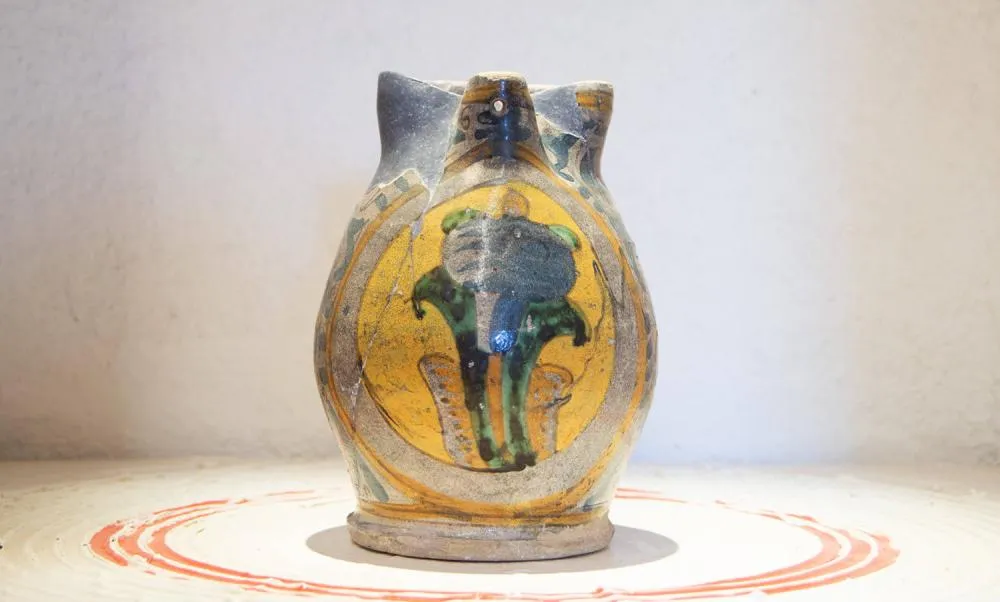
This small maiolica jug was made from an ivory-coloured clay body. The base was then coated with a white glaze. Today, its original colours appear altered by a dull grey patina caused by chemical reactions with sulfur compounds present in the well where it was found. These deposits also affected the decorative pigments applied over the glaze, muting the brilliance of the original colours.
Its shape reflects the model used for most Montelupo jugs produced between the late 16th and early 17th centuries. It features a flared disk-shaped foot supporting an ovoid body, topped by a short neck, a trilobed mouth with a flat rim and a ribbon handle.
The decoration, common to most Montelupo artefacts, follows a compositional scheme featuring: a central medallion containing various figurative motifs covering the entire oval field, while animal and phytomorphic ornaments occupy the remaining surface areas of the jug, with the prevalence of a stylized “Persian palmette” motif.
On the jug, the decoration inside the medallion, enclosed within an oval painted in black and bordered externally with giallo ferraccia (a particular ceramic yellow tending toward orange), features a floral motif characteristic of the Western tradition. At the centre of the oval stands a flower, probably a lily, set against a yellow background. The lily is depicted frontally: at the centre of the decoration a large funnel-shaped petal appears, painted in blue and light blue, filled with prominent stamens, behind which emerge two sepals of similar size. The leaves are rendered in a “watercolour-like” green, while the stem is painted in varying shades of yellow.
The full range of colours used in the central decoration and background mirrors those found on ceramics with the so-called ‘houses’ motif, as well as on other Montelupo wares recovered from the well of Allai.
At the time of its discovery, the jug was in only fair condition and had to be reconstructed from seven fragments, which were carefully cleaned, reassembled and integrated to restore the missing section of the handle and the broad band between the rim and the neck.
Comparable artefacts have been found in Prato, Rome, Genoa and Florence, and are also preserved in the International Museum of Ceramics in Faenza and in collections in the Netherlands. The decorative style and the presence of the mark “R°” - only partially legible on this jug - suggest a dating between the late 16th and early 17th centuries.