
Textile art in Sardinia boasts a tradition stretching back thousands of years and represents a fundamental chapter in the island’s history and cultural identity.
In the sheep farming communities of Sardinia, the ready availability of raw wool has always provided the raw material for handwoven textiles made on traditional looms. The weavers worked with a variety of intricate techniques, passed down from generation to generation.
Until the second half of the 19th century, production was mainly tied to the needs of domestic life (clothing, chest covers, tablecloths, saddlebags, bread-making cloths, towels - only to name a few) circulated within local and regional systems of production and exchange. Almost every household owned a loom and its related tools and many women, after an 'home-apprenticeship', became skilled custodians of this ancient craft.
From the early 20th century onward, with the development of the applied arts in Sardinia, Sardinian textile production began reaching the national market; and it evolved, renewing its visual language, without ever losing touch with its traditional artisanal roots.
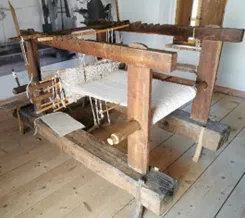
The symbol of this ancient tradition is the horizontal loom, originally designed for domestic use, it allows wool, cotton and silk threads to be stretched and woven together through different techniques, creating fabric through the interlacing of threads.
Like the example displayed here, the horizontal pedal loom is a dismantlable machine built from woods gathered locally by artisans - oak, holm oak, chestnut, or juniper. Its structure is simple: two trestles, formed by heavy horizontal and parallel wooden beams, support all the moving parts and rest on supports firmly anchored to the floor. Vertical boards holding two toothed horizontal bars stand at the ends of the beams. These boards are pierced with holes containing the “subbi”, perfectly parallel cylindrical elements used to wind the warp threads. The warp is raised through a system of reeds where the “licci”, small cotton cords tied together, are attached. Through connecting rods, these reeds are linked to the pedals. By pressing and lifting the pedals, the warp threads separate so the weft can be inserted. Above the trestles sits the “cassa battente”, or beater frame, whose function is to press the weft threads together in different ways. The movement depends on the weaver, who has already decided what kind of textile to create and which weaving technique to use. The comb inserted inside the beater frame separates the warp threads and determines their density.