
DIMENSIONS: h. 17 cm × diameter 9.5 cm × rim diameter 8.5 cm
MATERIAL: maiolica coated with white glaze and painted
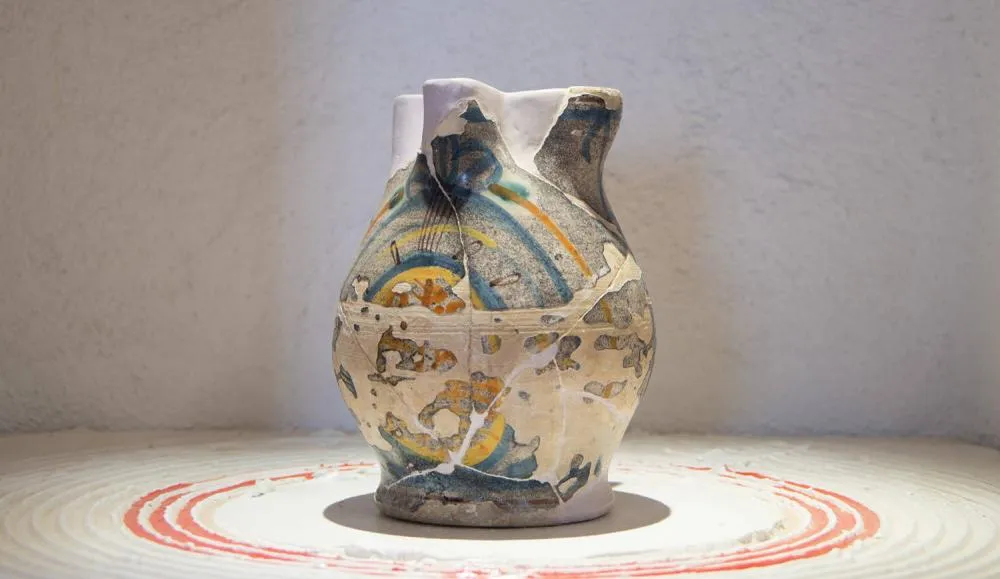
This small maiolica jug was made from an ivory-coloured clay body. The base was then coated with a white glaze. Today, its original colours appear altered by a dull grey patina caused by chemical reactions with sulfur compounds present in the well where it was found. These deposits also affected the decorative pigments applied over the glaze, muting the brilliance of the original colours.
Its shape reflects the model used for most Montelupo jugs produced between the late 16th and early 17th centuries. It features a flared disk-shaped foot supporting an ovoid body, topped by a short neck, a trilobed mouth with a flat rim and a ribbon handle.
The decoration, common to most Montelupo artefacts, follows a compositional scheme featuring: a central medallion containing various figurative motifs covering the entire oval field, while animal and phytomorphic ornaments occupy the remaining surface areas of the jug, with the prevalence of a stylized “Persian palmette” motif.
The central medallion bears the “Trigram of Saint Bernardino” — a sequence of three letters forming a single sound associated with Saint Bernardino — encircled by a decoration of hatched lobes. Owing to the fragile condition of the vessel when it was discovered, which prevented a clear philological reconstruction of the oval motif, only part of the Bernardinian symbol can now be identified: the elongated vertical stroke of the “H” in the trigram IHS (the first three letters of the name of Jesus in Greek, ΙΗΣΟΥΣ — Iesûs) appears surmounted by a cross.
Painted in a yellow ferraccia pigment - a colour symbolising glory and divinity - the inscription stands prominently in the foreground, emerging directly from the vessel’s originally white background. It is framed by a double oval border rendered in yellow and blue, the traditional colours associated with the Trigram of Saint Bernardino.
Very similar to a piece in the Galeazzo Cora Collection in Faenza, this artefact can be daed to the late 16th to the early 17th century.
When it was discovered, the jug was in extremely poor condition. It has since been painstakingly reconstructed from twelve fragments, which were cleaned, reassembled, restored, and carefully painted where parts were missing.