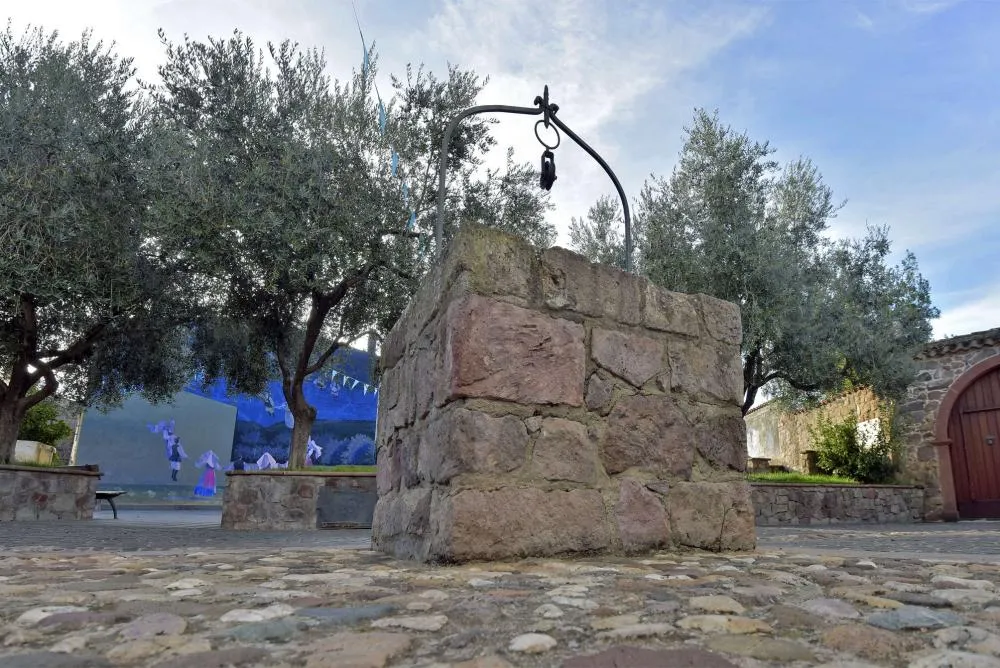

In Piazza dei Balli stands “Su Putzu Mannu”, a Great Well which, as its name suggests, was the village of Allai’s main water source for a long time. Square in shape and cut directly into the rock, the well reaches a depth of 13.5 meters, where a rich underground spring still flows. The trachyte blocks that form its walls are carefully fitted together in multiple rows. 6 meters below the square, a large, 6 metres wide chamber opens out, once used as a water reservoir.
In 1983, during emptying and cleaning operations, hundreds of jugs, pitchers, plates, tablewares and more than seven thousand pottery fragments were discovered inside the well completely by chance and recovered by the Archaeological Superintendency following a report from a private citizen.
Most of the recovered jugs are glazed over about one third of their height and some are decorated with incised designs made using a pointed tool or stick. These objects were probably produced in local workshops. Sources attest to the long-standing tradition of the Oristano“figoli” (ceramic artisans specialised in the production of pottery vessels) who were active in the area as early as the 15th century.
Among the finds in the well, though in smaller numbers, were also “imported” artifacts, including grey-blue glazed Ligurian fragments with stylized floral decoration, as well as a few Catalan ceramic shards.
The largest group of non-local ceramics, however, come from the Tuscan workshops of Montelupo Fiorentino. These were mainly jugs, along with a smaller number of plates and bowls, all decorated with colourful glazes and dating from the late 16th to the early 17th century. Exactly how, when and why these extraordinary late-Renaissance ceramics arrived in Allai remains a mystery. Similar Montelupo artefacts have nevertheless been discovered elsewhere in Sardinia during archaeological excavations in Cagliari, Nurachi, Iglesias, San Vero Milis and Sant’Antioco.